
Abstract on the artwork: “Seen and unseen”
When we start looking at anatomy of animals and humans which is 3 dimensional, it is represented in study guides and anatomy books as 2-dimensional and so much is lost between the translation of the anatomical structures and the 2-dimensional drawings and representations. Anatomic drawings are made for students to understand the anatomy, but so much is “lost in translation” for example how a muscle tenses under the skin, textures, contours, colours, or a different viewpoint of the anatomy. Descriptions of anatomy in science are based on four imaginary planes that intersect the body when in anatomical position. These planes are known as: Median plane (midline or the midsagittal plane); Sagittal plane (These planes are parallel to the median plane); Frontal (coronal) plane (It divides the body into an anterior (front) and posterior (back) part) and Transverse plane (divides the body into a superior (upper) and inferior (lower) portion.
The idea of the “Seen and unseen” is showing the viewer/ participant a different viewpoint on anatomy as it is not so straight forward as a 2-dimensional drawing. In the work I display different bones with photo or x-rays slotted into grooves behind the bones for the viewer/participant to takeout and look at. Look at the different viewpoints, colours, and textures. I placed bones in the exhibition for the viewer/ participant to touch and look at in the hope that they try to figure out where the pieces would fit, what they are and what they would attach to.
The artwork is exhibited in a “curiosity cabinet” style using medical trollies that is used in day-to-day operations to display the artwork. Cabinets of Curiosity or Wunderkammers started in the late sixteenth century, where they would exhibit a wide variety of objects, paintings, and artifacts to tell a particular story about the world or that period, thus the idea of learned entertainment. The cabinets allowed the participant the “practices of looking”, and attentive looking are what makes it possible to not only study physical objects in depth, but to make connections between these objects and the practices or environments that shaped them.
The displays on the medical trollies have carefully been selected and consist of Equine/Horse bones and related artefacts. The tin boxes and holders come from the “Boer war” and the “First World War” where horses were part of the wars, carrying soldiers to the front lines, going into battle and carting supplies.
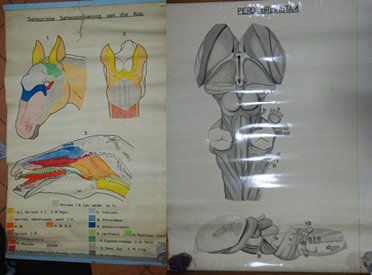
The artwork consists of artwork in the form of sculptures, photos, drawings, and objects relating to the subject matter. The sculptures are all placed on wooden blocks, painted black with slots in for photos printed on paper or Perspex. The clear Perspex allows for light to shine through to give the idea that something should be behind it and that there is more to be seen. The backdrop or curtain behind the medical trollies consists of photos printed on paper, transparencies or Perspex, drawings, x-rays, and old vinyl cut-outs all 400 x 300 mm hung from hooks like the carcasses of dead animals. The images on the backdrop reflexes different angles of the artworks on display on the medical trollies in front of them. The vinyl cut-outs come from the archives and was in use 30 to 40 years ago. The lectures or students tried to explain the complexity of the anatomy with flat out of shape drawings. I found them beautiful in their simplicity, so I started cutting them up and drawing on them with whiteboard markers.
The x-rays used in the exhibition was also scratched out of storage units as that type of printed x-ray that is developed like an old photo is no longer in use as everything is computerised, but even with the computers there is still a lot that is unseen.
The bones used in the exhibition comes either from the archives or from the abattoir, in which case I stripped the flesh and boiled the bones in water with 10% peroxide.
I want the viewer/participant to get curios about what they are looking at and the objects on display that each tells a story. I want them to interact with the work and view the work from different angles and different aspects.
I want the viewer/participant to walk away with a bit of new knowledge about anatomy or a better understanding thereof, I want them to start viewing the unseen in life.